
Huwag Mag-Panic: Business Decisions During a Crisis
Huwag Mag-Panic: Business Decisions During a Crisis
Remember when the government told everyone not to panic buy — and millions of Filipinos rushed to the grocery anyway?
We laughed at it. We shared the memes. And then, without realizing it, many of us did the exact same thing with our businesses.
We rushed. We made fast decisions based on fear. We changed things that didn’t need changing and ignored things that did. Panic doesn’t always look like running to the grocery store. In business, panic looks like slashing prices overnight, dropping products without thinking, or making big moves based on one bad week of sales.
As your Business Mentor, let me say this clearly: panic is the most expensive business decision you can make. Here is how to avoid it.
Why Panic Is So Costly
When we are afraid, our brain wants to do something — anything — to feel in control. That urge is natural. But in business, acting fast without thinking clearly almost always makes the situation worse.
Businesses that panic during a crisis don’t fail because of the crisis itself. They fail because of the decisions they made while panicking.
Here are the most common panic moves Filipino entrepreneurs make during a crisis — and why each one backfires:
- Slashing prices to chase sales
Feels like it will bring customers back. In reality it trains your market to expect lower prices permanently — and destroys your margin when you can least afford it.
- Stopping all marketing and promotion
Feels like saving money. But going silent means your competitors who stayed visible will own your customers’ attention when the crisis passes.
- Making big pivots based on one bad week
Feels decisive. But one bad week during a crisis is not a signal to reinvent your whole business. It’s a signal to look more closely at your numbers.
- Letting go of good people too quickly
Feels like cost-cutting. But losing trained, loyal staff to save one month’s wages often costs far more to rebuild when business picks up again.
Reacting vs. Responding — Know the Difference
This is one of the most important lessons I share with my mentees. There is a big difference between reacting and responding — and it determines everything.
| ⚠ REACTING | ✓ RESPONDING |
| • Driven by emotion and fear | • Driven by analysis and calm |
| • Fast and unconsidered | • Deliberate and considered |
| • Based on one bad data point | • Based on real data and trends |
| • Makes you feel in control | • Actually keeps you in control |
| • Often creates more problems | • Creates solutions that stick |
A reactor sees fuel prices jump and immediately cuts staff. A responder sees the same thing, reviews the numbers for a week, and finds a smarter way to reduce costs without losing people.
The 3-Question Decision Check
Before making any major business decision this week, run it through these three questions honestly:
Q1 Am I making this decision based on data — or based on how I feel right now?
| ⚠ Reaction: Mostly how I feel right now | ✓ Response: Based on real numbers and facts |
Q2 Have I given this situation at least a week before deciding it’s a real trend?
| ⚠ Reaction: No — things feel urgent now | ✓ Response: Yes — I’ve watched it for a while |
Q3 Can I reverse this decision if I turn out to be wrong?
| ⚠ Reaction: No — it’s a permanent change | ✓ Response: Yes — I can adjust it later |
If you answered like a reactor on any of the three — pause. Sleep on it. Talk to a mentor or a trusted peer before you move forward.
A Calm 3-Step Framework for Crisis Decisions
Here is what I tell every entrepreneur I mentor when they come to me in the middle of a crisis:
- Stop and separate facts from feelings
Write down what you actually know — not what you fear, not what might happen. Just the facts. Sales this week vs. last week. Costs today vs. last month. When you see numbers on paper, fear shrinks.
- Identify your one biggest pressure point
Don’t try to solve everything at once. Ask yourself: what is the single thing that would make the most difference if I fixed it this week? Focus there first. One problem solved is better than five problems half-addressed.
- Make the smallest move that reduces the pressure
Think small, reversible actions first. Not restructuring — rescheduling. Not quitting — adjusting. Not a full pivot — a small test. Small moves give you data. Data leads to better decisions.
The Butz Take
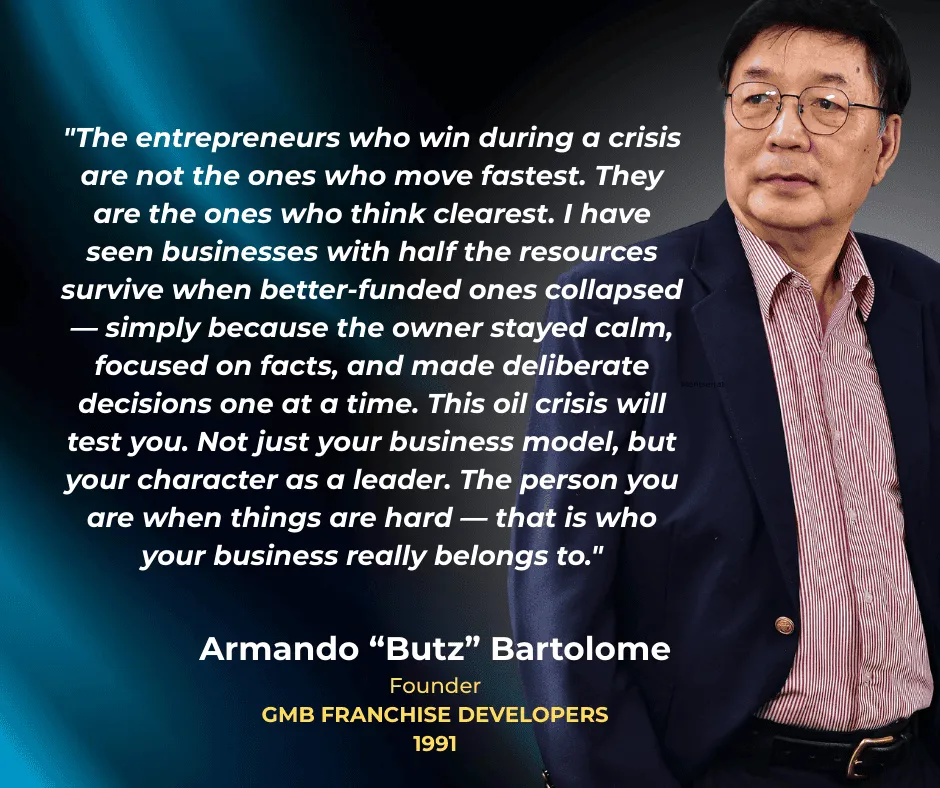
“The entrepreneurs who win during a crisis are not the ones who move fastest. They are the ones who think clearest. I have seen businesses with half the resources survive when better-funded ones collapsed — simply because the owner stayed calm, focused on facts, and made deliberate decisions one at a time. This oil crisis will test you. Not just your business model, but your character as a leader. The person you are when things are hard — that is who your business really belongs to.”
Before you make your next big business move this week, ask yourself honestly: am I reacting — or am I responding?
Your negosyo deserves your clearest thinking. Especially now.
Let’s Talk About It
What is the biggest business decision you are facing right now because of the oil crisis? Share it in the comments — sometimes just writing it down helps you see it more clearly. And if you want to talk it through, reach out at [email protected]
About the Author
Armando “Butz” Bartolome is known as The Business Mentor, inspiring individuals and organizations to develop an entrepreneurial mindset. He has assisted countless micro-entrepreneurs who are now known brands across the Philippines. Contact him at [email protected] or visit butzbartolome.com.